How to Choose a Bamboo Skewer Supplier in China: A B2B Sourcing Guide (2026)
Finding a factory that can make bamboo skewers is easy. Finding one that delivers the same dimensions, surface quality and lead time on the fifth order as on the first is much harder. Choosing on unit price alone is the most common sourcing mistake. A low quote can hide loose tolerances, splintered surfaces, unclear documentation or a delivery schedule that was never confirmed. Qualifying a supplier means verifying evidence before you commit to a bulk order. This guide helps you answer three questions: how to screen suppliers, how to judge whether the evidence a supplier gives you is credible, and how to reduce quality and delivery risk on a bulk order. It includes a supplier scorecard, ten questions to send to any supplier, a red-flag table and a six-step evaluation process. To choose a reliable bamboo skewer supplier in China, evaluate more than the quoted price. Confirm the supplier's manufacturing capabilities, product specifications, quality-control procedures, applicable food-contact documentation, and ability to maintain consistency across repeat orders. Before committing to bulk production, review representative samples, agree on measurable acceptance criteria, and confirm production lead times, packaging requirements and shipping terms in writing. Define every critical parameter in writing before you ask for a quote, then check that the supplier can hold those parameters across a whole production run, not just in a hand-picked sample. What to check: Use a specification sheet like this in your inquiry: How to make specifications measurable. Do not rely on nominal dimensions alone. For each critical parameter, record the target value, acceptable tolerance, measurement method and approval criteria, and confirm these with the supplier before you approve the production sample. For example, the sheet should distinguish the required skewer length from its permitted variation, define how diameter is measured, and describe the acceptable condition of the pointed tip and finished surface. Agree the exact tolerances for your product and application rather than assuming they are universal industry standards. Ask the supplier to describe each production stage and show how defects are caught and recorded. "Strict quality control" is a claim, not evidence. What to check: A framework you can ask the supplier to explain: This is not a claim that every factory runs the same three checks. It is a way to structure your questions. Then separate three kinds of evidence, because each proves something different: Ask for product-specific test reports that match your destination market, and confirm that each document covers the exact product and material you are buying. What to check: Requirements differ by market. In the EU, for example, food-contact materials fall under the framework in Regulation (EC) No 1935/2004, and other markets have their own rules. No single set of certificates applies to every bamboo skewer in every country, and a factory-level certificate does not by itself prove that a specific skewer meets a market’s food-contact requirements. Where to verify the food-contact rules in each market: When a supplier sends a test report, check that it names the framework or standard the product was tested against. A report that does not name one is hard to place in any market, and the last two entries above are management-system certifications rather than product-level proof. A test report is only useful for your purchasing decision when its scope, tested parameters and product description match the requirements you need to verify. A report should not be treated as proof of compliance with requirements it does not cover. For a closer look at how stick and skewer buyers test compliance, see how to verify food-safety standards for wooden skewers. Buying principle: verify the applicable requirements for your destination market, and confirm that the supporting documents cover the actual product being ordered. Check with official regulators or your own compliance advisor rather than relying only on supplier marketing pages. Ask about capacity available for your product and specification, then check whether the supplier has actually delivered at that level. What to check: Separate three ideas that are often blended together: Ask the supplier to confirm the capacity available for your specific product, quantity and requested delivery window. Where possible, compare that commitment with previous order records or other verifiable delivery evidence. Annual production figures alone do not establish that a supplier can accommodate your order on schedule. Compare suppliers like for like: the same product specification, pack quantity, carton configuration, order volume and delivery terms. Then evaluate total landed cost and the potential cost of quality or delivery problems. What to check: Total cost is more than unit price, freight and duty. Packaging, inspection, rework, replacement orders and delivery delays can all add cost. A lower unit price does not always mean a lower total sourcing cost. Illustrative example (hypothetical numbers, not market prices): Supplier A quotes a lower price per pack than Supplier B. But Supplier A’s cartons hold fewer packs and load less efficiently, so more cartons and more freight are needed per shipment. If substandard product also has to be sorted or replaced, the gap can close or reverse. Break "lead time" into separate stages and confirm each one in writing. Production time and total delivery time are not the same number. Also confirm shipment documents and how order status will be communicated. For import paperwork such as HS codes and customs documents on skewer shipments, see importing bamboo skewers from China. Prefer suppliers whose identity, production and inspection evidence can be verified, and who say clearly who is responsible when a batch fails inspection. Check the factory identity and manufacturing location, how quickly and specifically the supplier answers technical questions, and whether written specifications and sample-approval records exist. Agree the complaint and corrective-action procedure before you order. The red-flag table below shows what gaps in each area look like. A trading company is not automatically unreliable. What matters is how transparent its supply chain is and how much control it has over production. Neither is automatically better. Choose based on verified factory access, quality responsibility and order records, not on how the company describes itself. Whichever you pick, ask for factory evidence, order records and a clear statement of who is responsible when a batch fails inspection. A wider view of the available bamboo and wooden skewer types is in the bamboo skewers buying guide. Copy these into your inquiry email: Specific questions get specific answers. "Are you a reliable supplier?" cannot be verified; the questions above can. A single red flag does not prove a supplier is unreliable. Treat each one as a prompt for further checking. Score each supplier on the evidence you have actually reviewed, not on what the supplier says. The weights below are a suggested starting point for buyers, not an industry standard. Adjust them to your product and market. Score each area: To calculate a supplier's total, multiply each area's weight by its score divided by 2, then add the results. A supplier scoring 2 in every area scores 100%. Use pass/fail gates for must-haves. Food-contact compliance, product safety and any other mandatory requirement should not be offset by a high total score. If a requirement is non-negotiable for your market, make it a separate pass/fail check, and do not order from a supplier that fails it. Turn the checks above into a six-step process: Prepare measurable specifications, target quantity, packaging and destination market. Review factory capabilities, documents and relevant export experience, and score them with the scorecard. Check dimensions, surface quality, tips and suitability for the intended use. Document tolerances, inspection requirements and approved reference samples. Clarify MOQ, production lead time, packaging, shipping and quality responsibilities. Check the actual goods against the approved requirements before planning repeat orders. Before you release bulk production, confirm each of these: Move to bulk production only when every required item has been verified. When evaluating a bamboo skewer supplier, look for evidence that connects the supplier’s stated capabilities to the product you intend to purchase. Relevant evidence may include actual production footage, documented inspection procedures, product specifications, representative samples and supporting test reports. These materials help you judge whether a supplier’s processes match your order requirements. At YADA Industrial, buyers can review the following before placing a skewer order: If your specification is not yet fixed, send your target length, diameter, tip style and packaging to YADA Industrial and request a sample and a quotation against your own specification. Buyers working on application-specific programmes can also review multi-scenario skewer sourcing solutions and how bamboo BBQ skewers are made from forest to table. Verify manufacturing capabilities, product specifications, inspection procedures, applicable compliance documents, sample quality and repeat-order performance. Factory evidence and written acceptance criteria are more useful than price or general quality claims alone. Confirm dimensions, tolerances, tip style, surface quality, packaging quantity, applicable documentation, MOQ, lead time and shipping terms. Approve representative samples and document acceptance criteria before production begins. MOQ depends on the supplier, dimensions, packaging, customization and order requirements. Request separate quotations for standard and customized orders rather than assuming one MOQ applies to every specification. Depending on the destination market and product, buyers may need food-contact test reports, material information, traceability records and relevant management-system certificates. Verify the scope and validity of each document rather than assuming every certificate covers every product. Measure several pieces against the written specification, including length, diameter, tip shape and surface condition, and check that the sample comes from representative production rather than a hand-picked selection. Test it in the intended use, keep an approved reference sample on both sides, and record the results before you approve production. Lock the written specification and approved sample, and require the supplier to tell you before changing materials, process or packaging. Compare each batch against the reference sample and agreed tolerances, keep batch inspection records, and review the first shipment before increasing order volume. The right bamboo skewer supplier is the one whose products, process, quality control, documents, lead times and commercial terms you can verify before you place a bulk order. Start with measurable specifications, test samples against written criteria, and review your first shipment before scaling up. Next steps: Planning a bulk bamboo skewer order? Send YADA Industrial your target length, diameter, tip style and packaging, and request a sample and quotation against your own specification.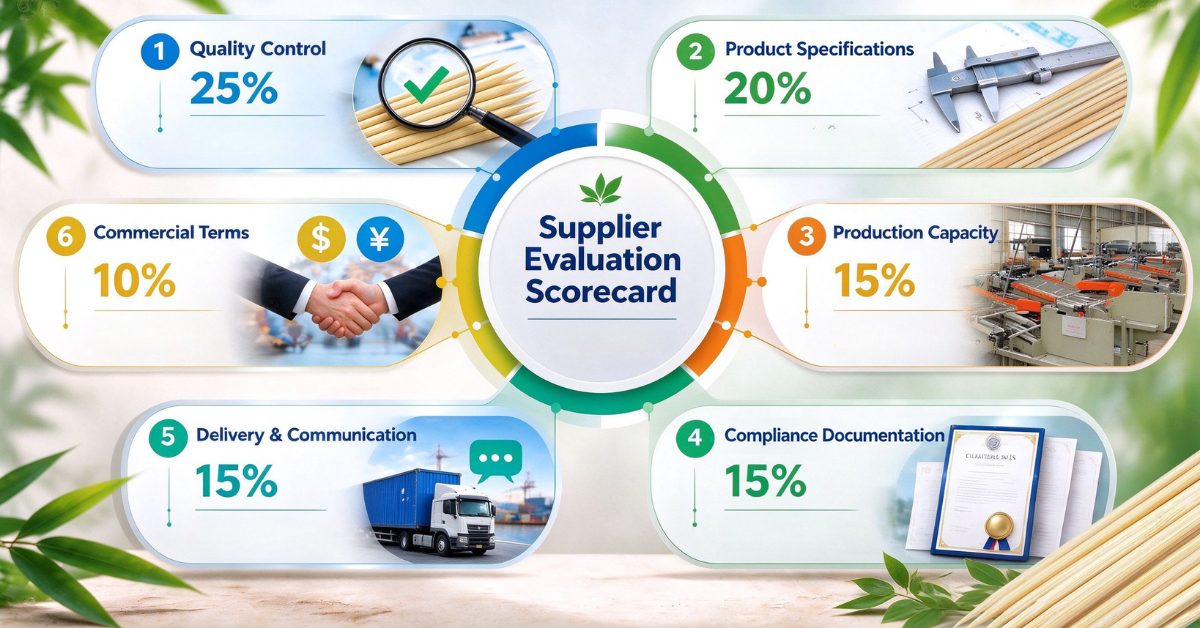
What to Check Before Choosing a Bamboo Skewer Supplier
1. How Do You Confirm a Supplier Can Meet Your Product Specifications?
Specification What buyers should define Length Required finished length in mm Diameter Nominal diameter and acceptable tolerance Tip Point style and acceptance criteria Surface Splinters, roughness and visible defects Packaging Pieces per pack, carton quantity and labeling 2. How Do You Judge a Supplier’s Manufacturing Process and Quality Control?
Evidence What it helps verify Factory or process video Whether the described process can be observed Written QC procedure What the supplier says should be checked Inspection records What was actually checked and recorded 3. Which Food-Contact Compliance Documents Should You Request?
Market Reference What it governs Official source United States FDA 21 CFR 174 Indirect food additives eCFR, 21 CFR Part 174 United States Harmonized Tariff Schedule HS codes and duty rates USITC HTS European Union Reg. (EC) No 1935/2004 Food-contact materials European Commission Germany LFGB Food-contact articles German law database Global (voluntary) FSC chain of custody Certified fibre origin FSC certificate search Global (voluntary) BRCGS certification Factory food-safety systems BRCGS 4. How Do You Verify Production Capacity and Repeat-Order Consistency?
5. How Do You Compare MOQ, Pricing and Total Landed Cost?
6. How Do You Reduce Lead-Time and Shipping Risk?
Stage What to confirm Sample approval Who approves, what is approved, and the reference sample kept by both sides Production scheduling When your order enters the production schedule Production completion Quoted production time for your quantity Loading Packaging, carton marking and container loading International shipping Shipping terms, responsibilities and transit time 7. How Do You Judge Supplier Transparency and Quality Responsibility?

Bamboo Skewer Manufacturer vs. Trading Company: Which Should You Choose?
Evaluation factor Manufacturer Trading company Direct process visibility Usually more direct Depends on factory access Custom specifications Depends on production capability Depends on manufacturing partners Product sourcing range Often focused on its own capabilities May offer broader product ranges Quality responsibility Must be verified Must be verified Best fit Buyers prioritizing process control and repeat production Buyers seeking consolidated sourcing or broader supplier coordination Questions to Ask a Bamboo Skewer Supplier Before Placing an Order
Red Flags to Watch for When Sourcing Bamboo Skewers from China
Red flag Risk What to do Vague specifications Inconsistent product between orders Require written tolerances and an approved reference sample Unsupported quality claims No way to verify inspection Ask for the written QC procedure and sample inspection records Unclear compliance scope Reports may not cover your product Check the product, material and tested parameters on each report Unverified capacity claims Delays or lower quality in peak season Ask for available capacity for your specification and delivery history Uncertain lead times Late delivery Separate sample, production, loading and shipping time in writing Unclear quality responsibility Disputes over defective batches Agree the complaint and corrective-action process before ordering Supplier Evaluation Scorecard: How to Compare Bamboo Skewer Suppliers
Evaluation area Suggested weight Evidence to review Product specifications 20% Written specifications and sample measurements Quality control 25% Inspection procedures and actual records Compliance documentation 15% Applicable product-specific reports Production capacity 15% Available capacity and delivery history Commercial terms 10% MOQ, pricing and total landed cost Delivery and communication 15% Confirmed lead times and order updates Total 100% — How to Evaluate a Bamboo Skewer Supplier Before Bulk Ordering
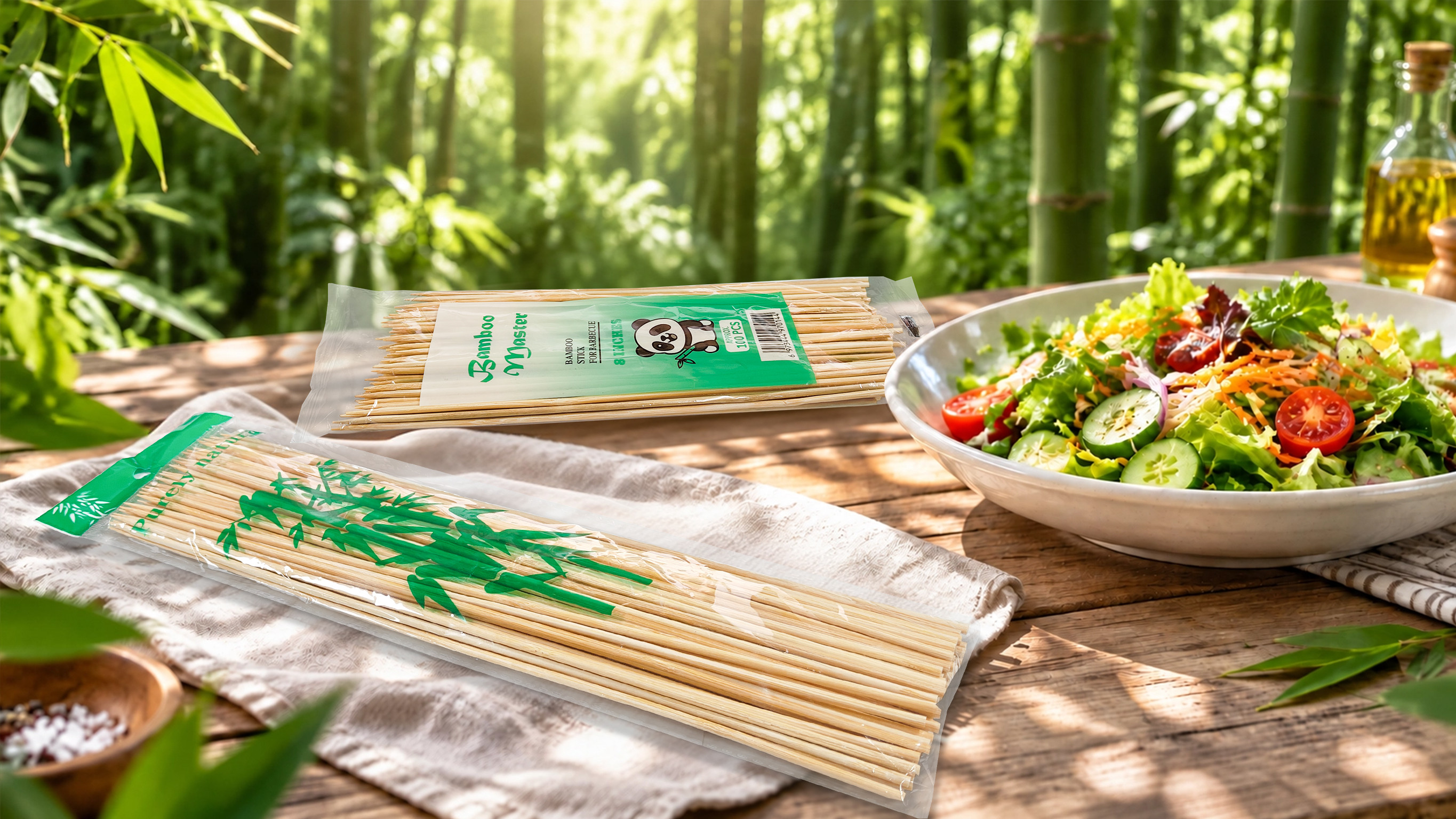
Why Manufacturing Evidence Matters When Choosing a Supplier
FAQ: Choosing a Bamboo Skewer Supplier in China
How do I find a reliable bamboo skewer manufacturer in China?
What should I check before ordering bamboo skewers in bulk?
What is the typical MOQ for bamboo skewers?
What documents should a bamboo skewer supplier provide?
How can I evaluate bamboo skewer samples before bulk production?
How can I reduce quality problems in repeat orders?
Conclusion: Choose a Supplier You Can Verify