Ice Cream Sticks for High-Speed Insertion Machines
High-speed moulding lines consume sticks at a pace that leaves very little room for error. At up to 48,000 sticks per hour, a line uses roughly 800 sticks a minute, or about 13 every second. One stick that is too thick, too short or visibly bowed can interrupt that rhythm.
That is why choosing a stick by nominal size alone is not enough. The right stick for your machine is one that stays inside the dimensional and straightness requirements of your insertion system, batch after batch.
This guide sets out a practical process for matching ice cream sticks to a high-speed insertion line, then explains each check in detail: sizes, tolerances, straightness, inspection and the questions to ask a supplier.
Quick answer
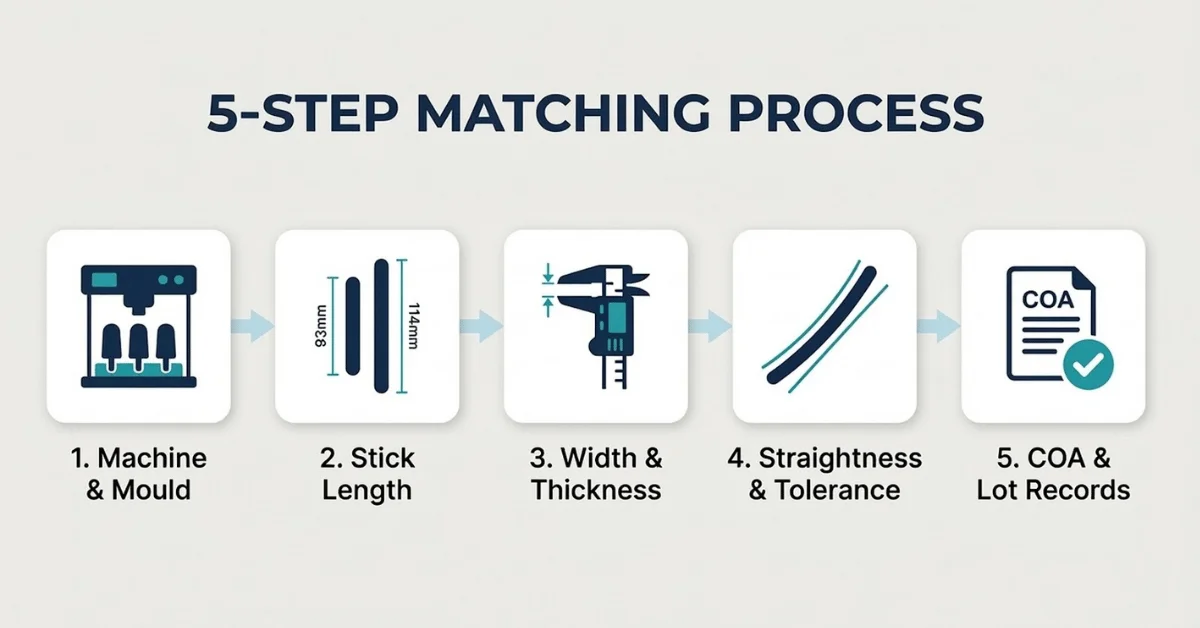
Matching a stick is a sequence, not a single number. Confirm the machine and the mould first, then the required stick length, then width and thickness, then the dimensional and straightness tolerances, and finally how the supplier records inspection results by lot. YADA’s standard formats are 93 × 9.6 × 2 mm and 114 × 9.6 × 2 mm in birch or bamboo, with other lengths and thicknesses available on request.
Key takeaways
- 01There is no universal ice cream stick size for every insertion machine. The required size depends on the mould, the product format and the insertion-system specification.
- 02YADA’s two standard formats are 93 × 9.6 × 2 mm and 114 × 9.6 × 2 mm, with other lengths and thicknesses available on request.
- 03Check length, width and thickness together, not length alone.
- 04Ask for straightness limits by type (curve, zig-zag and banana) and see how they are recorded.
- 05Ask how sticks are inspected, and whether results are kept by lot.
- 06To confirm a match, give your supplier your machine brand and model, mould specification, product type, target stick dimensions and expected line speed.
01 How Do You Match an Ice Cream Stick to a Machine?
Matching is a sequence of checks, and the order matters. Start with the product and the mould, then work through dimensions and quality evidence.
- 01Step 1: Identify the machine and mould
Note your machine brand and model, whether it is a rotary or inline system, and the mould and finished product format. These are the starting point for every other decision.
- 02Step 2: Confirm the required stick length
Decide whether your product format calls for a 93 mm stick, a 114 mm stick or a custom length. The machine brand alone does not settle this.
- 03Step 3: Check width and thickness
Confirm that the stick’s width and thickness, and their tolerance ranges, suit your insertion mechanism. These set the physical cross-section entering the machine.
- 04Step 4: Verify straightness and tolerances
Ask for the supplier’s dimensional tolerances and straightness limits for curve, zig-zag and banana deformation.
- 05Step 5: Confirm supplier inspection records
Ask how the sticks are inspected and whether inspection results are recorded and available by lot.
The sections below explain each step in more detail.
02 What Size Ice Cream Stick Does the Machine Require?
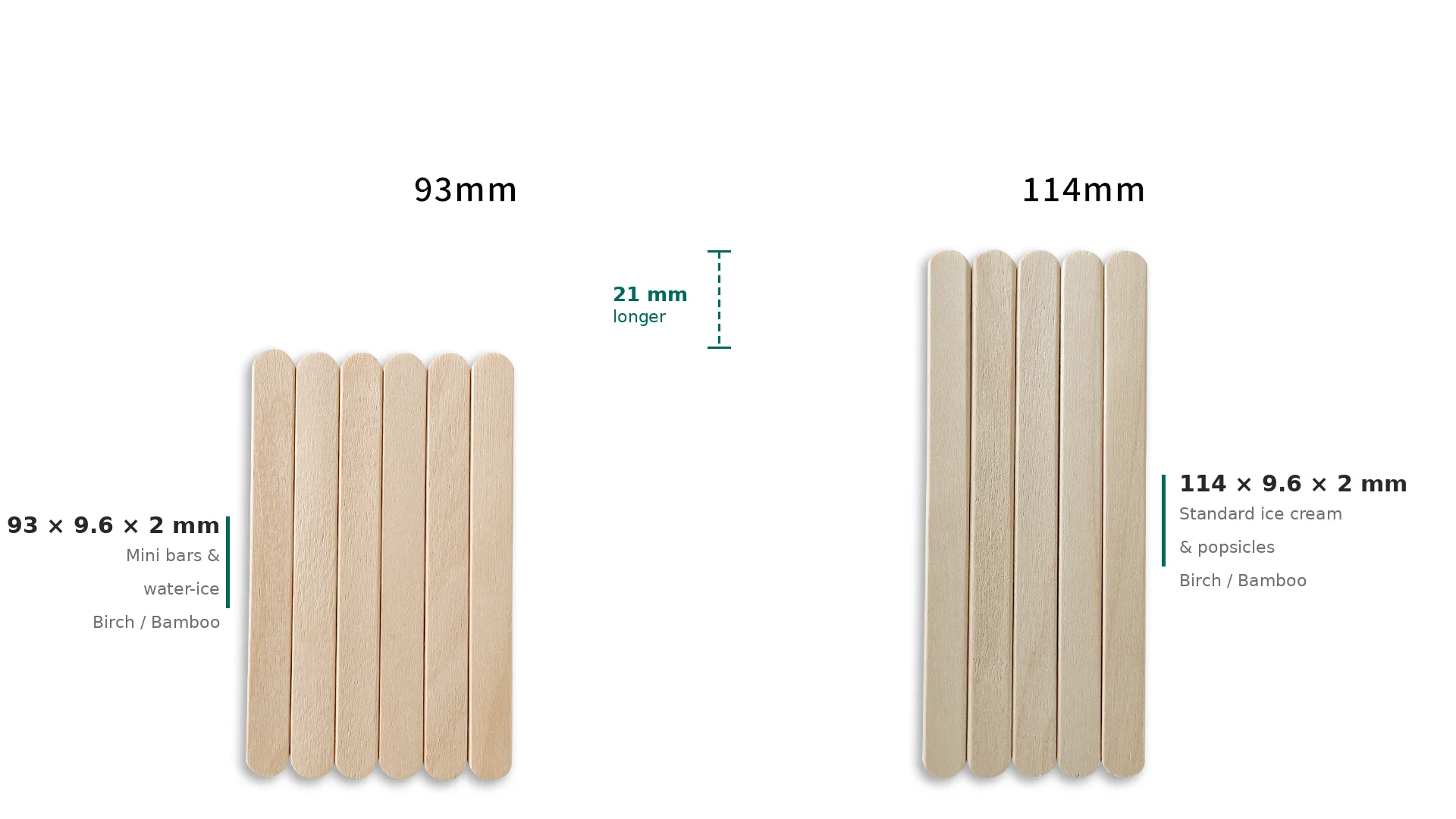
The required size depends on your mould and product format, not on one universal standard. What can be defined clearly are the two standard formats in YADA’s current ice cream stick range and their specifications.
93 mm ice cream sticks
Used for children’s or mini bars, and for water-ice products.
| Specification | 93 mm stick |
|---|---|
| Nominal size (L × W × T) | 93 × 9.6 × 2 mm |
| Actual length range | 92–94 mm |
| Actual width range | 9.2–9.8 mm |
| Actual thickness range | 1.8–2.2 mm |
| Weight per piece | 1.25 g ± 0.05 g |
114 mm ice cream sticks
Used for standard stick ice cream and popsicles.
| Specification | 114 mm stick |
|---|---|
| Nominal size (L × W × T) | 114 × 9.6 × 2 mm |
| Actual length range | 113–115 mm |
| Actual width range | 9.2–9.8 mm |
| Actual thickness range | 1.8–2.2 mm |
| Weight per piece | 1.32 g ± 0.05 g |
Does width and thickness matter, or only length?
They all matter. Length determines how the stick fits the mould and the finished product. Width and thickness determine the cross-section that enters the insertion mechanism. Confirm all three against your machine and moulding-line requirements.
| Stick | Nominal size | Typical application |
|---|---|---|
| 93 mm | 93 × 9.6 × 2 mm | Mini bars, water-ice |
| 114 mm | 114 × 9.6 × 2 mm | Standard ice cream, popsicles |
03 What Stick Length Works for Different Moulding Lines?
Match the stick to the mould, not just the machine brand
The machine brand does not by itself determine stick length. The mould and the finished product format are the starting points. A single brand can run different products and mould configurations, which is why we do not publish a chart pairing each brand with one stick length.
The reliable route is to supply your machine model and mould requirements, then confirm the stick specification against them.
What does line speed have to do with stick quality?
Line speed does not tell you which length to choose. What it tells you is how demanding the line is on stick consistency, because every finished unit consumes one stick.
The stated capacities of common stick-insertion moulding lines show the range:
| Moulding line | Stated capacity |
|---|---|
| Gram Equipment | Up to 48,000 sticks/h |
| Tetra Pak | Up to 43,200 sticks/h |
| Technogel | Up to ~36,000 sticks/h |
| Wuxi Danxiao / Nanjing Shanlin | 6,000–22,000 sticks/h |
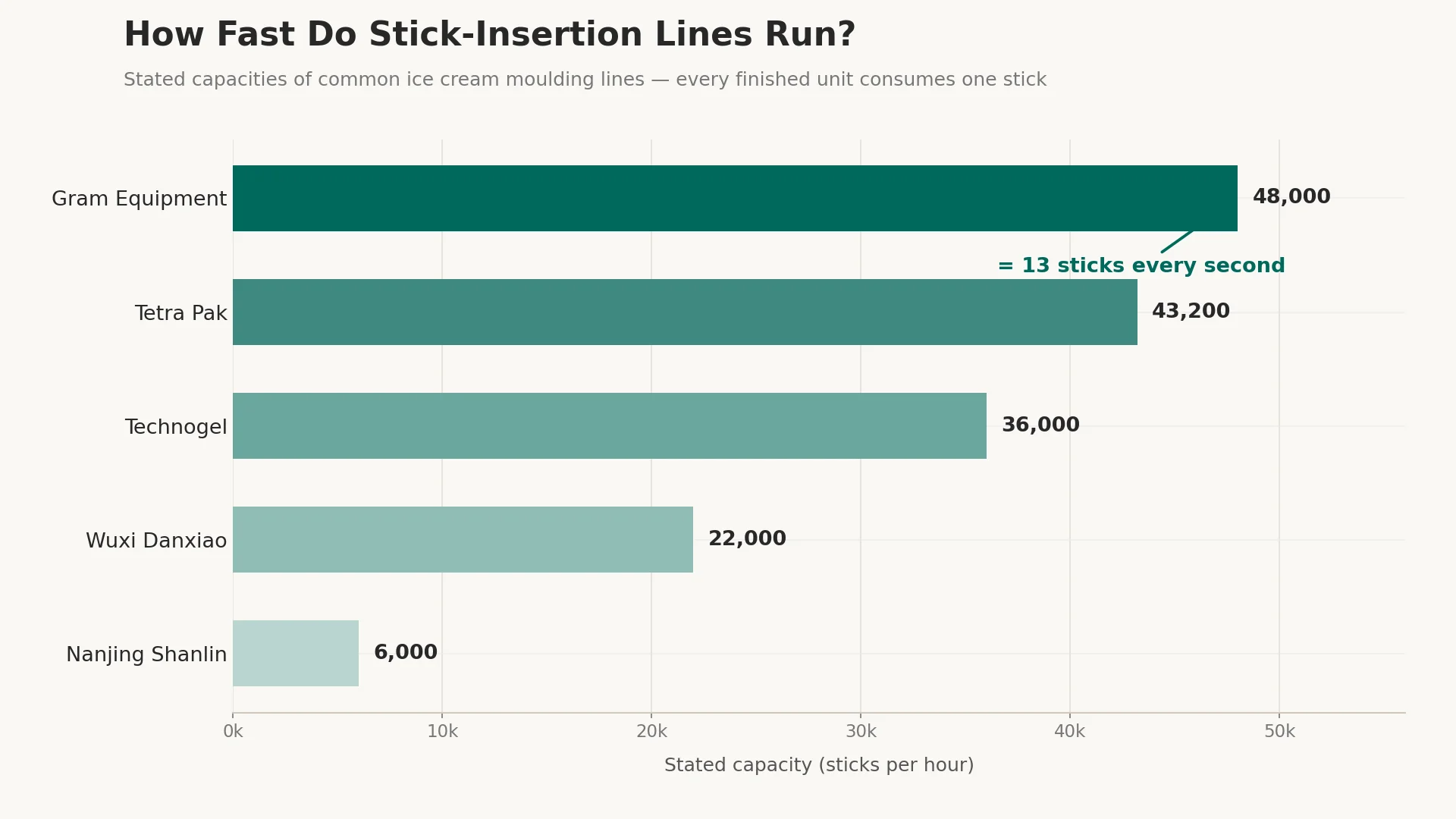
The faster the line, the less room there is for out-of-tolerance sticks to be caught and removed by hand.
Which insertion moulding lines are YADA sticks compatible with?
YADA’s 93 mm and 114 mm birch and bamboo sticks are specified for compatible stick-insertion moulding applications from Tetra Pak, Gram Equipment, Technogel, Wuxi Danxiao and Nanjing Shanlin, as well as equivalent systems. They are also compatible with LAIeF, Snowball, Fu Chen and Catta 27, and equivalent rotary and inline stick moulders.
Compatibility with a brand does not mean every model from that brand uses the same stick. Always confirm the exact specification against your own machine and mould.
04 Why Does Stick Straightness Matter on High-Speed Lines?
Why straightness matters at 48,000 sticks per hour
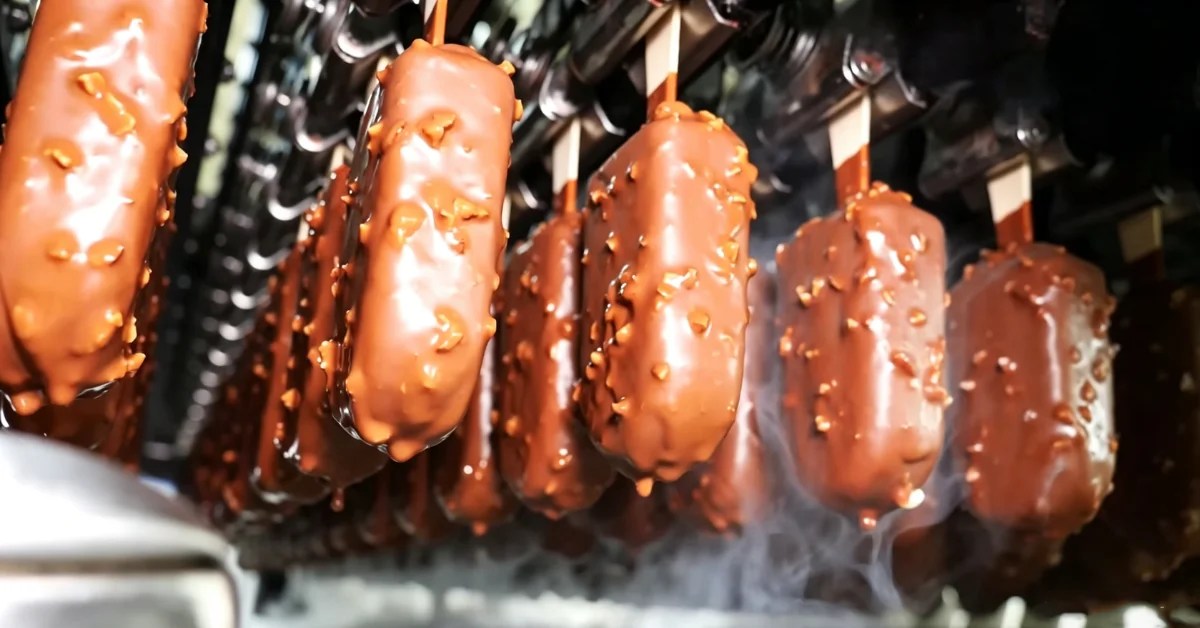
Each finished unit consumes one stick, so stick supply is tied directly to line speed. At this pace, stick consistency becomes a line-efficiency issue and not only a product-quality issue.
How can warped sticks affect insertion?
Warped or inconsistent sticks can contribute to:
- misfeeds
- inconsistent insertion
- insertion failure
- line stoppages
How a given defect affects a given machine varies by design, which is another reason to discuss your own line with the supplier. For a step-by-step troubleshooting sequence, see how stick jams happen on high-speed filling lines.
What are curve, zig-zag and banana?
- Curve: the stick bends in one direction along its length.
- Zig-zag: the stick deviates in more than one direction.
- Banana: a pronounced bow along the length of the stick.
YADA’s straightness specification
| Deformation type | YADA limit |
|---|---|
| Curve | ≤ 2.8 mm |
| Zig-zag | ≤ 2.8 mm |
| Banana | ≤ 10.4 mm |
These are separate straightness criteria and should be evaluated according to the supplier’s inspection method and COA definition. Do not compare the figures directly with each other, and ask any supplier how each one is measured.
05 What Dimensional Tolerances Should Buyers Check?
A nominal size gives you the target. The tolerance shows how far real sticks may drift from it. When comparing suppliers, ask for both the tolerance and the actual production range.
| Dimension | Nominal | Tolerance | Actual range |
|---|---|---|---|
| Length (93 mm stick) | 93 mm | +1 / −1 mm | 92–94 mm |
| Length (114 mm stick) | 114 mm | +1 / −1 mm | 113–115 mm |
| Width | 9.6 mm | +0.2 / −0.4 mm | 9.2–9.8 mm |
| Thickness | 2 mm | ± 0.2 mm | 1.8–2.2 mm |
| Weight (93 mm stick) | 1.25 g | ± 0.05 g | 1.20–1.30 g |
| Weight (114 mm stick) | 1.32 g | ± 0.05 g | 1.27–1.37 g |
Weight as a batch-consistency indicator
Weight is not a substitute for dimensional inspection. It can be used as an additional batch-consistency indicator alongside dimensional inspection.
06 How Can Suppliers Verify Ice Cream Stick Quality?
Certificates are important, but buyers should also look at production controls, inspection methods and lot-level records. Together these form a chain: production, inspection, documentation.
Moisture control
Moisture content is another specification buyers should request and monitor when sourcing sticks for high-speed insertion. YADA’s current specification is ≤ 12% moisture content for kiln-dried sticks.
Two-stage polishing
Two-stage polishing removes burrs and surface irregularities that can trigger misfeeds, and it produces a consistent cross-section for repeatable insertion. The finished surface is mechanically sanded, splinter-free and free of burrs.
14-camera optical sorting
YADA uses 14-camera optical sorting, which inspects 100% of sticks and rejects any that fall outside tolerance. Warp is held within 2.8 mm.
COA and lot-level records
Straightness results are recorded on the COA for each lot, and lots are batch-traceable for audit readiness. This lets a buyer review data rather than rely on a general assurance.
Food-contact and FSC documentation
Each YADA shipment includes:
- COA (certificate of analysis)
- Phytosanitary / FSC certificate
- FDA (21 CFR) and German LFGB food-contact declarations
YADA also holds ISO 9001 and BRC credentials, and products are SGS tested. Buyers should confirm which documents apply to their own market.
07 Does Material Affect Machine Matching?
YADA supplies both natural birch and natural bamboo ice cream sticks, each FSC-certified, with no fillers and no chemical treatment or bleaching. For machine matching, the primary checks stay the same whichever material you choose: dimensions, tolerances, straightness, moisture, surface finish and documentation.
| Property | Birch | Bamboo |
|---|---|---|
| Material | Natural birch (Betula spp.) | Natural bamboo |
| Formats | 93 mm and 114 mm | 93 mm and 114 mm |
| Food contact | FDA (21 CFR) and German LFGB compliant | FDA (21 CFR) and German LFGB compliant |
08 Can Ice Cream Sticks Be Customized for a Specific Machine?
Yes. If your insertion line needs a specification outside the standard formats, these options are available:
- Custom length: other lengths available on request.
- Custom thickness: other thicknesses available on request.
- OEM / ODM: stick branding and specifications to customer requirements.
Send the machine requirement and target dimensions to the supplier before production, so the specification can be agreed first. Food-safe ink logo printing and custom packaging can also be arranged.
09 What Should Buyers Ask an Ice Cream Stick Supplier?
- Dimensions
Can the supplier provide exact length, width and thickness, plus tolerances and the actual production range?
- Straightness
Can the supplier provide curve, zig-zag and banana limits, and are they recorded on the COA?
- Inspection
Are sticks inspected manually or optically, and does inspection cover 100% of sticks? Are results recorded by lot?
- Machine compatibility
Can the supplier match sticks to your insertion machine? Be ready to provide the machine brand and model, mould specification, product type, required stick dimensions and expected production speed.
- Samples before bulk production
For a new machine or mould configuration, buyers can request samples to confirm the stick specification before moving to bulk production.
10 YADA Ice Cream Sticks for High-Speed Insertion Lines
YADA is a manufacturer based in Dalian, China, with 30 years of experience in wooden and bamboo foodware. For insertion lines, the approach follows one sequence: specification, production, inspection, documentation.
- Specification: 93 × 9.6 × 2 mm and 114 × 9.6 × 2 mm birch or bamboo sticks, with custom sizes on request.
- Production: kiln-dried to ≤ 12% moisture and finished with two-stage polishing.
- Inspection: 14-camera optical sorting of 100% of sticks, with warp held within 2.8 mm.
- Documentation: COA with lot-recorded straightness, phytosanitary or FSC certificate, and FDA and LFGB declarations with each shipment.
FAQ: Ice Cream Stick and Machine Matching
What is the standard size of an ice cream stick?
YADA’s two standard formats are 93 × 9.6 × 2 mm (mini bars and water-ice) and 114 × 9.6 × 2 mm (standard ice cream and popsicles). Actual length ranges are 92–94 mm and 113–115 mm respectively.
What size stick is used for high-speed ice cream machines?
It depends on the mould and product format, not on the machine brand alone. YADA supplies standard 93 mm and 114 mm sticks for different applications, and can supply custom sizes on request.
How do I match ice cream sticks to an insertion machine?
Confirm your mould and product format first, then verify stick length, width, thickness, straightness, moisture and lot-level inspection records with your supplier.
Why does ice cream stick straightness matter?
Excessive curvature or warp can interfere with consistent stick insertion, especially on high-speed lines where one stick is consumed with every cycle.
What tolerance should I check when buying ice cream sticks?
Length: +1 / −1 mm; width: +0.2 / −0.4 mm; thickness: ± 0.2 mm; curve: ≤ 2.8 mm; zig-zag: ≤ 2.8 mm; banana: ≤ 10.4 mm.
How can I verify that sticks are suitable for my machine?
Give your supplier the machine brand and model, mould specification, product format and required stick dimensions. Then request the dimensional tolerances, straightness data, COA and inspection records.
Which machines are YADA sticks compatible with?
YADA sticks are specified for compatible stick-insertion moulding applications from Tetra Pak, Gram Equipment, Technogel, Wuxi Danxiao and Nanjing Shanlin, plus LAIeF, Snowball, Fu Chen and Catta 27, and equivalent rotary and inline stick moulders. Confirm the exact size against your own model and mould.
Can 93 mm and 114 mm ice cream sticks be customized?
Yes. Other lengths and thicknesses are available on request, along with OEM / ODM.
Conclusion: Match the Stick to the Line, Not Just the Product
To match an ice cream stick to a high-speed insertion machine, confirm the mould and product format first, then verify stick length, width, thickness, straightness, moisture and lot-level inspection records.
In short: Machine → Mould → Stick dimensions → Tolerances → Straightness → Inspection → Documentation.
Send us your machine brand, model, required stick dimensions and annual volume. YADA can provide the specification sheet, COA information and a quotation for 93 mm and 114 mm birch or bamboo ice cream sticks.
View ice cream stick specificationsRelated reading: How to Prevent Ice Cream Stick Jams on High-Speed Filling Lines.