What Are Popsicle Sticks Made Of? A Complete Sourcing Guide
Sep 10,2026
Most commercial popsicle sticks are made from natural wood, especially birch, though bamboo is a growing option for certain applications. That is the short answer. But if you are sourcing popsicle sticks for ice cream production, foodservice, or retail packaging, the material is really just the starting point. You will also need to think about size, surface quality, food-contact safety, and whether a supplier can deliver the same quality on order 50 as they did on order 1.
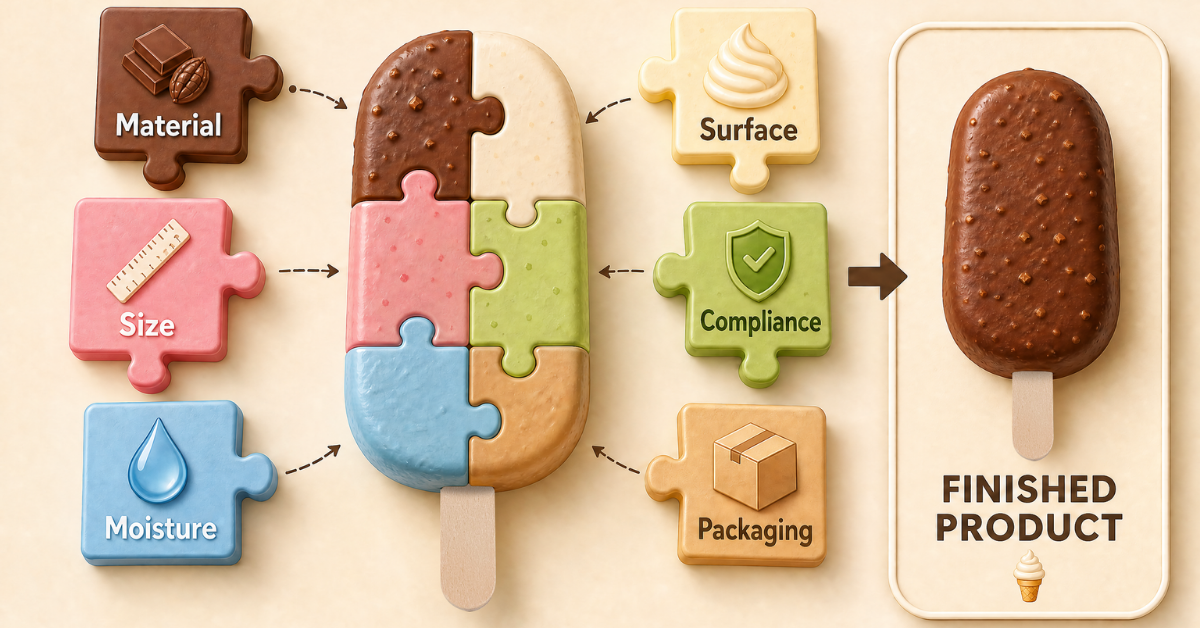
Quick answer: most commercial popsicle sticks are made from wood, with birch being one of the most common choices and bamboo used for certain applications. The material is only one part of the decision — you will also want to look at size consistency, surface smoothness, moisture control, food-contact compliance, packaging, and supplier reliability once you are buying in volume.
This guide walks through both sides of that: what the sticks are actually made of, and what you can check for before you place an order.
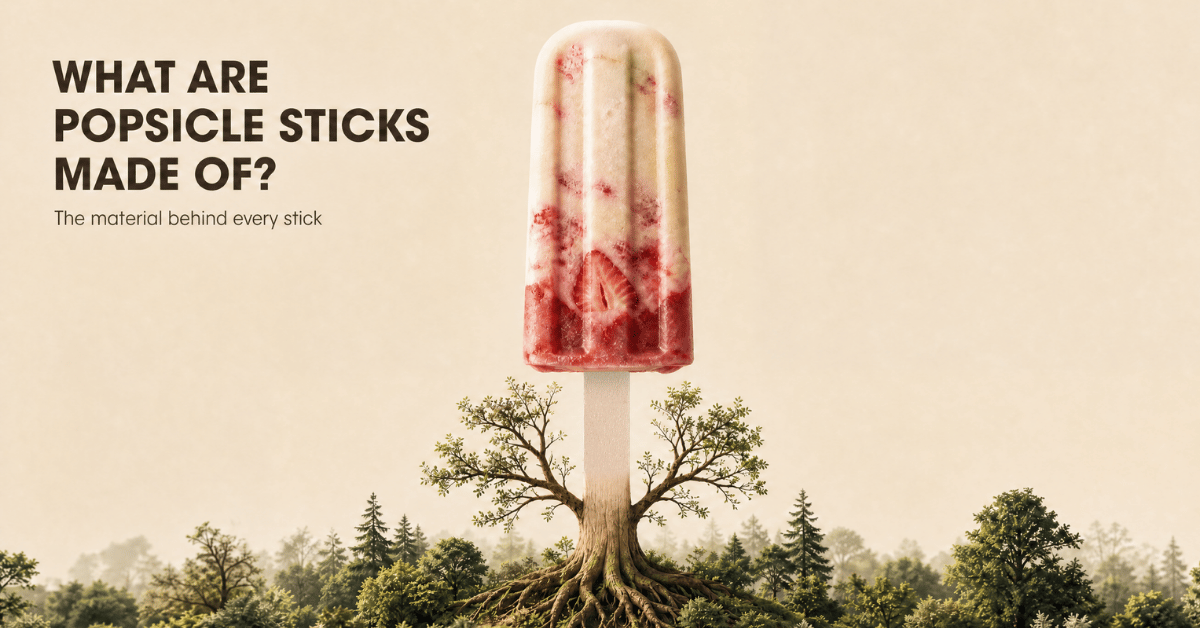
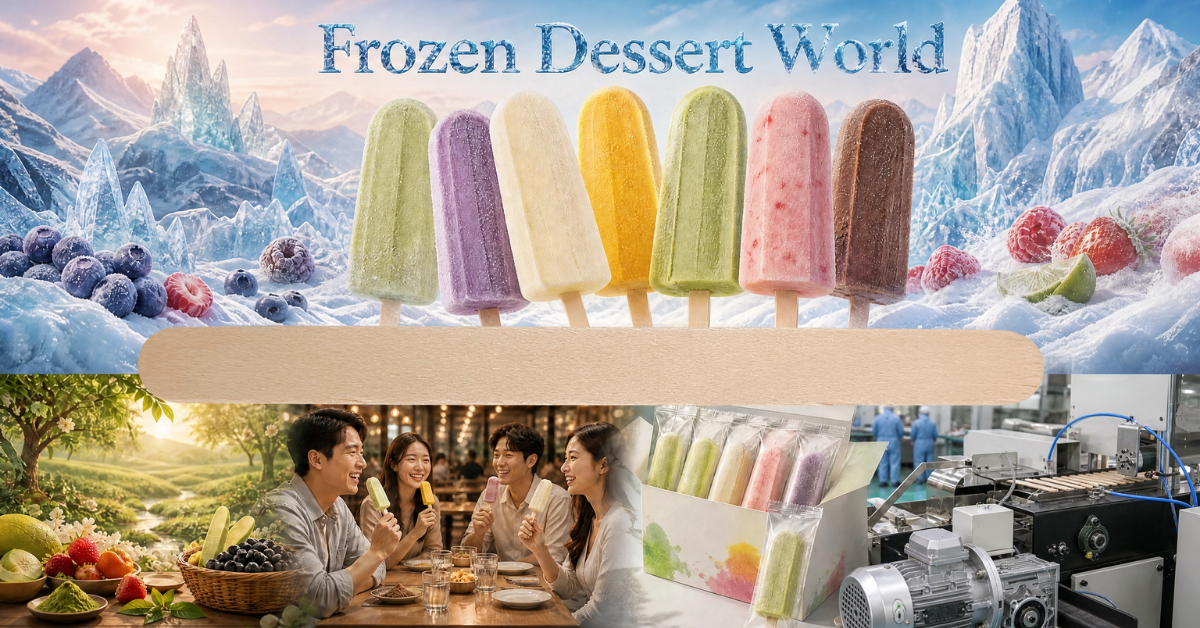
Most commercial popsicle sticks are made of birch wood; bamboo is the main alternative for eco-positioned product lines.
What Are Popsicle Sticks Made Of?
Wood Popsicle Sticks
Wood is the default material for a reason. It has a naturally smooth surface once processed, holds its shape well, and has enough rigidity to stay rigid in a frozen dessert without snapping or bending. It has also been used in food-contact applications for decades, so the manufacturing processes and quality standards around it are mature.
But “made of wood” does not tell you much on its own. What you actually want to know is whether that wood can be processed into consistent dimensions, a smooth surface, and a product that is genuinely safe for direct food contact — not just whether the raw material is technically wood.
Bamboo Popsicle Sticks
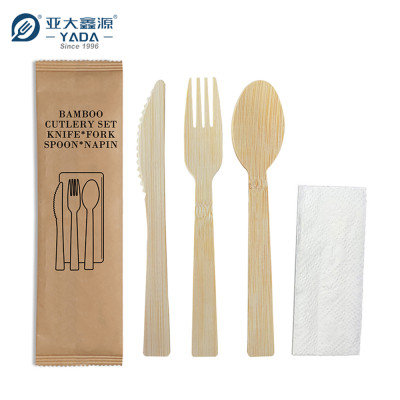
Bamboo is the other material you will come across, and it has its own strengths: it is fast-growing and renewable, lightweight, naturally strong along the grain, and has a distinct natural look that some brands prefer for packaging appeal.
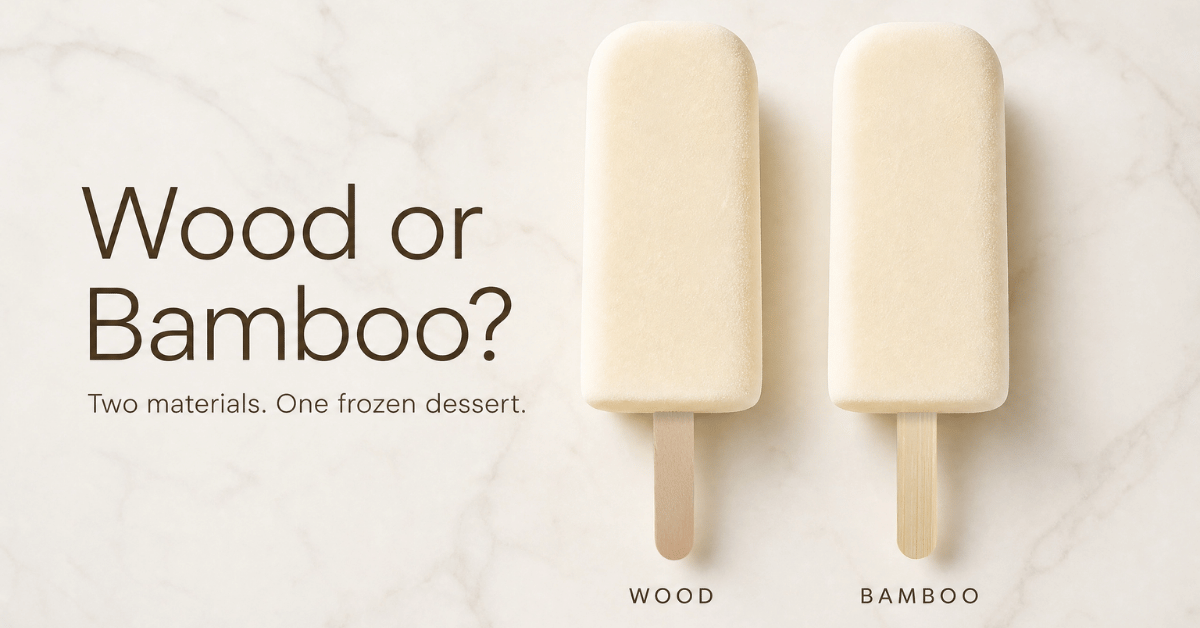
If you are weighing bamboo against wood, it helps to know they are not interchangeable in every application. They differ in strength profile, standard dimensions, surface finish, and how they need to be processed. Before you switch from one to the other, you can ask your supplier to walk you through these differences rather than assuming the swap will be seamless.
What Type of Wood Is Used for Popsicle Sticks?
Within “wood,” birch is the most common choice, though other hardwoods are used depending on the market and application. The right wood for your product depends on the strength you need, the finish you are after, your cost target, and the requirements of the market you are selling into. There is not one universally “correct” wood — you are looking for the one that fits your specific use case, and your supplier should be able to explain why they recommend it for yours.
Why Is Birch Wood Commonly Used for Popsicle Sticks?
Birch shows up so often in popsicle and ice cream sticks because of a combination of practical traits: a relatively straight grain, fairly uniform texture from piece to piece, and a light natural color that looks clean in finished packaging. It also processes well — it cuts, sands, and polishes without excessive splintering, which keeps production efficient.
If you are placing a bulk order, the real advantage is not the appearance — it is what that consistency does downstream. You can generally expect straighter, more uniform grain to hold stable dimensions and surface quality across a large production run, which means less sorting on your end and fewer sticks that look or feel slightly off compared to the sample you approved. If you have ever opened a shipment where some sticks felt noticeably rougher or thinner than others, this is usually why.
Birch is preferred for its straight grain, uniform texture and light color — traits that keep dimensions and surface quality stable across large runs.
Wood vs. Bamboo Popsicle Sticks: Which Is Better?
Neither is a clear winner across the board. Here is how they generally compare:
Factor
Wood
Bamboo
Strength
Good, holds shape well
Good, especially along the grain
Surface finish
Smooth when properly processed
Smooth when properly processed
Appearance
Light, natural tone
Distinct natural bamboo look
Renewability
Depends on the wood source
Fast-growing, renewable
Processing
Mature, well-established methods
Requires suitable processing setup
Cost
Depends on species and size
Depends on grade and processing
Best suited for
Ice cream, foodservice, general use
Specific food applications and eco-positioned products
You can use the table below to match the material to what you are actually optimizing for:
If you prioritize...
Consider...
High-volume ice cream production
Wood
Tight dimensional consistency across large orders
Wood
Standard, established ice cream stick applications
Wood
A bamboo-based product line or eco-positioning
Bamboo
A distinct natural bamboo look for packaging
Bamboo
Sustainability messaging tied specifically to bamboo
Bamboo
If you are a large-volume ice cream producer optimizing for consistency and price, you will usually land on wood. If bamboo carries real marketing weight for your brand, it may be worth the added cost. Both are reasonable choices — what matters is being clear on which of these you are actually optimizing for before you decide.
How Are Popsicle Sticks Made?
Knowing the production process helps you understand why quality varies so much between suppliers — and where problems tend to originate.
Raw material selection. This is where quality is largely decided before any cutting even happens. Wood that is poorly selected — too young, uneven grain, hidden defects — carries those problems all the way through to the finished stick.
Cutting and sizing. Raw material is cut into the rough dimensions of the final product. Precision here sets the ceiling for how consistent the final sizing can be.
Drying. Moisture content has to come down to a stable level. Improper drying can increase the risk of cracking, warping, or moisture-related quality issues later — sometimes only showing up after the sticks have already sat in your warehouse for a while.
Shaping and polishing. This is where the rounded edges and smooth surface come from. It directly affects whether the finished stick is safe and comfortable in direct contact with food — no splinters, no rough edges.
Quality inspection. Thickness, length, width, moisture level, and surface finish are checked against a specification. This is the step that determines whether the batch you receive matches the last one you ordered.
Packing and shipment. Packaging needs to protect the product from moisture and damage during transit, especially for long international shipping routes.
A weak link at any single step — bad raw material, rushed drying, sloppy inspection — tends to show up later as inconsistent sticks, complaints from your own customers, or product that jams on your line. You will usually learn more by asking a supplier how they handle each of these steps than by just asking for a quote.
From raw material selection to packing: every step in the process affects the consistency of the finished stick.
What Should Buyers Check When Sourcing Popsicle Sticks?
This is really the core question, and it is worth spending more time on than most buyers do.
Material quality. You can ask what wood or bamboo species is being used, whether it is properly matured, and whether the grain is clean — free of knots, cracks, and visible discoloration.
Size consistency. You will want to confirm length, width, thickness, and the tolerance range the supplier works within. Even small dimensional differences can throw off automated packing lines or change how a finished frozen dessert looks on the shelf.
Surface smoothness. Check for splinters, rough edges, burrs, or uneven polishing. For a product that goes directly into someone’s mouth, this is not a cosmetic detail — it is a safety one.
Moisture control. Properly dried and stored product resists cracking, deformation, and mold during storage and shipping. If a supplier cannot clearly explain their drying process, you can take that as a reason to ask more questions before ordering in volume.
Food-contact safety and compliance. Requirements vary depending on where your product is going — different markets have different applicable regulations. You can confirm what is relevant to your destination market before placing an order, and ask suppliers what documentation or testing they can provide to support that.
Packaging and shipping protection. Popsicle sticks are frequently shipped overseas, often by sea. You can ask whether the packaging is designed to protect against moisture, compression, and dust over a multi-week transit, not just a short domestic delivery.
Batch-to-batch consistency. A single good sample does not guarantee the next five container loads will match it. You can ask suppliers how they hold dimensions, surface finish, moisture, and appearance steady across repeat orders — this matters more once you move from a trial order into regular purchasing.
Dimensional consistency, surface smoothness and moisture control are the checks that separate a reliable bulk supplier from a risky one.
What Certifications Should a Popsicle Stick Supplier Have?
For food-contact products, certifications are the fastest way to check whether a supplier's quality and food-safety claims are independently verified rather than self-declared. The ones that matter most for wooden and bamboo popsicle sticks are FSC® for the raw material, BRCGS for food safety at the factory, ISO 9001 for quality management, and food-contact compliance with FDA and LFGB requirements for the markets you sell into.
Quick answer: the four to ask for are FSC® chain-of-custody certification, BRCGS food-safety certification, ISO 9001 quality management certification, and documented food-contact compliance with FDA and LFGB requirements.
Certification
What it covers
What it tells you as a buyer
FSC®
Responsible forest sourcing and chain of custody
The wood or bamboo is traceable to responsibly managed sources — usually expected for retail and eco-positioned product lines.
BRCGS
Food-safety management at the manufacturing site
An independent audit has checked hygiene, contamination control, traceability, and product safety at the factory that makes your order.
ISO 9001
Quality management system
Documented, repeatable processes — the foundation of batch-to-batch consistency when you reorder.
FDA
US food-contact requirements for materials and articles
The material and finish are suitable for direct food contact in the US market.
LFGB
German food-contact regulation for materials in contact with food
Supports food-contact compliance for Germany and other markets that test against LFGB-based requirements.
A certificate is only useful if it is current and relevant to your order. When you ask for documentation, it helps to request the certificate itself rather than a logo, and to check the issuing body, the scope of certification, the validity dates, and whether the certified production site is the one that will actually run your order — a certificate issued to a different facility says very little about your shipment.
We hold FSC®, BRCGS, and ISO 9001 certification, and our wooden and bamboo popsicle sticks are produced to meet FDA and LFGB food-contact requirements. Current certificates and food-contact test reports can be provided with your quotation.
What Specifications Should You Confirm Before Ordering?
You can save yourself a lot of trouble by not asking for a quote before you have defined these specifications — a quote without them is not really comparable to anyone else’s. It helps to work from an actual checklist rather than trying to remember everything in a single conversation with a supplier. Before placing an order, you can confirm:
Material (wood species or bamboo grade)
Length, width, and thickness
Shape and edge finish
Surface finish requirements
Moisture specification
Packaging type and unit count per bag or carton
Private labeling or custom printing needs
Minimum order quantity (MOQ)
Production lead time
Shipping method and requirements
Compliance documents needed for your market
Getting these answers in writing before production starts saves a lot of back-and-forth later — and it gives you something concrete to hold the supplier to if the finished product does not match expectations.
How to Choose the Right Popsicle Stick Size
There is no single “standard” popsicle stick size that fits every use case — the right size depends on what you are actually making:
Application
Typical Size Direction
Mini or novelty ice cream
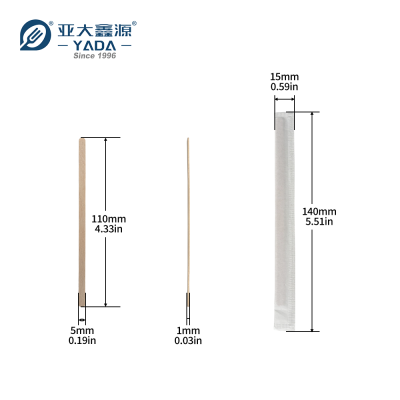
Around 93 mm (3.7 in) is a commonly used length.
Standard ice cream bars
Around 114 mm (4.5 in) is the most commonly seen commercial length.
Larger frozen desserts
Longer and often slightly wider, for extra structural support
Foodservice use
Depends on the serving format
Craft or retail use
Often different from food-grade specifications
Instead of just asking a supplier for “the standard size,” you can send them your dessert’s actual dimensions, weight, and how it is molded, and let them recommend a size that fits — that usually gets you a better answer than a generic spec sheet.
How Much Do Popsicle Sticks Cost?
There is no single universal price, because the final cost depends heavily on material, dimensions, order quantity, packaging, customization, and shipping terms. Comparing suppliers on unit price alone can be misleading — two quotes that look similar on paper can represent very different products once you factor in tolerance, surface quality, and what is actually included in the packaging.
Instead of just asking “what is your price,” you can ask:
What material is used, specifically?
What are the exact dimensions and tolerance?
What packaging is included in that price?
What quality checks are performed on each batch?
What is the MOQ?
What is the production lead time?
What compliance documentation is available?
If a supplier can answer these clearly and specifically, that is usually a better sign than one who just quotes a low number.
7 Questions to Ask a Popsicle Stick Supplier
Beyond price, here are questions you can ask before committing to a supplier:
What material and wood species do you use? — and can they explain why, beyond “it is what we always use”?
What size tolerances can you maintain? Ask for the actual tolerance range, not just the nominal dimensions.
How do you control surface smoothness? Rough edges and splinters usually trace back to a specific step in polishing — ask them to describe it.
How do you control moisture during production and storage? This is a good way to tell whether a supplier actually understands their own process or is just reciting a spec sheet.
What food-contact documents can you provide? And do those documents match the market you are actually shipping to?
What is your MOQ and production lead time? Get both numbers, not just one.
Can you hold the same specification across repeat orders? This is the question that separates a one-time supplier from a long-term one.
A good supplier should give you more than a competitive unit price — you should also get predictable quality and a supply chain you do not have to think about twice.
Frequently Asked Questions
Are popsicle sticks made of wood?
Most are, yes — wood is the most common material for commercial popsicle and ice cream sticks.
What kind of wood are popsicle sticks made from?
Birch is the most widely used, though other hardwoods are used depending on the market and application.
Are popsicle sticks made of birch?
Many are. Birch is popular because of its straight grain, uniform texture, and light color, which make it easy to process into a consistent, smooth product.
Can popsicle sticks be made from bamboo?
Yes. Bamboo is a viable alternative for certain applications, offering a renewable material with good strength, though it is processed differently from wood.
Are wooden popsicle sticks food safe?
Yes, wooden popsicle sticks can be suitable for direct food contact when they are manufactured with appropriate food-contact materials and meet the requirements of the target market. You should still confirm a supplier’s compliance documentation before ordering, since requirements vary by destination.
What size are standard popsicle sticks?
There is not one fixed universal standard, though around 114 mm (4.5 in) is a commonly seen length for standard ice cream bars, with around 93 mm (3.7 in) common for mini or novelty formats. Sizes vary based on the application.
Are popsicle sticks biodegradable?
Wood and bamboo sticks are generally biodegradable, though actual breakdown depends on the material, environment, and any coatings or treatments applied.
What is the difference between popsicle sticks and ice cream sticks?
In practice, the terms are often used interchangeably. Some minor differences in size or shape may exist depending on the intended dessert format.
How are wooden popsicle sticks manufactured?
The general process includes raw material selection, cutting and sizing, drying, shaping and polishing, quality inspection, and packing.
What should I check when buying popsicle sticks in bulk?
You can focus on material quality, size consistency, surface smoothness, moisture control, packaging protection, batch-to-batch consistency, and food-contact compliance — and confirm full specifications and documentation before ordering.
What Buyers Should Remember
Most commercial popsicle sticks are made from wood, while bamboo is another option for specific applications.
Material quality directly affects strength, smoothness, appearance, and batch-to-batch consistency.
For bulk purchasing, dimensional consistency and repeat-order reliability matter just as much as the material itself.
You can — and should — confirm food-contact safety and target-market requirements before placing an order, not after.
A reliable supplier offers more than a low price — you are also getting consistent quality and dependable supply, which matter more over the life of the relationship.
Not sure which popsicle stick size or specification fits your product? Share your dessert size, quantity, and packaging requirements, and we can help you compare the options that actually fit. You can review the Explore More Ice Cream Stick Options or send us an inquiry to start the conversation.