What Should Ice Cream Manufacturers Confirm Before Placing a Large Wooden Stick Order?
Before placing a large wooden ice cream stick order, confirm the product specifications, sample approval criteria, quality-control process, food-contact documentation, batch consistency, production capacity, lead time, shipping terms and supplier verification. Put the critical requirements in writing and ask for evidence before committing to volume. Although an ice cream stick is a relatively small component, inconsistent dimensions, surface defects or feeding problems can disrupt production on lines that depend on automated stick insertion. A quotation and an approved sample are useful starting points when buying bulk wooden ice cream sticks, but they do not show that every production batch will meet the same requirements. Buyers also need to know how quality is inspected, which documents apply to their market, whether the supplier can meet the schedule, and how problems will be handled. This guide comes from YADA Industrial (Dalian Yada Industrial Co., Ltd.), a wooden and bamboo tableware manufacturer in Dalian, China, operating since 1996. It sets out the checks to run before you approve production. The same questions can be used to evaluate any supplier, including us. The eight checks below follow the order a purchase actually runs in: specification, sample, quality control, documents, capacity, delivery, supplier reliability, and the final pre-order sign-off. You can also read the common pitfalls when choosing a wooden ice cream stick manufacturer for the mistakes buyers raise most often. Short answer: Only if the dimensions, tolerances, shape and material are written down and attached to the order. That written specification is the reference for sample approval, bulk production and incoming inspection. “Warp” is not a single measurement, so each deformation type needs its own limit and method. Limits that describe different shapes are not interchangeable, and comparing two quotes without them is meaningless. Three different shapes, three different limits. Ask every supplier how each one is measured before you compare quotes. Our guide to preventing ice cream stick jams explains the three types and what each one does to an insertion machine. For reference, YADA Industrial's 93 mm and 114 mm birch and bamboo sticks are specified at 93 × 9.6 × 2 mm and 114 × 9.6 × 2 mm, and its ice cream stick range runs from 72 mm to 114 mm. Buyer takeawayA written specification should be the reference for sample approval, bulk production and incoming inspection. Short answer: A sample should be approved against a defined standard, not because it looks good. An approved sample does not prove that mass production will match, but it gives both sides a shared quality reference. Write them into a specification sheet both parties sign, so the standard is measurable rather than impressionistic. Hold it for incoming inspection and repeat orders, and mark it so it cannot be mistaken for production stock. Agree in advance that any change to material, processing or specification needs written approval before it is implemented. The approved reference only matters if somebody measures against it at each stage. Buyer takeawayApprove a defined standard, not just a sample that looks good. Short answer: Ask what is checked, against which standard, how often and which records prove the result, then ask how the supplier repeats the approved standard lot after lot. “We have quality control” is not an answer, and one good sample shows only what a supplier can make once. Five control points. Ask which of them appear in the supplier written inspection criteria, and which are only checked when someone remembers. On your side, a short incoming-inspection record for each lot (lot number, delivery date, sample size, measured results, decision) lets you compare deliveries over time and shows whether a later problem began in production, in storage or on the line. A supplier should be able to explain how quality is controlled from incoming materials to final shipment. YADA Industrial's process, for example, has four stages: incoming material inspection, production monitoring, final quality inspection and shipment verification. For ice cream sticks, its jam-prevention guide describes kiln-drying to a moisture content of 12% or below, two-stage polishing and 14-camera optical sorting. Its About page also describes ERP-integrated production management and batch traceability, and you can ask to review a sample lot record to see how traceability works in practice. The same stages and questions can be used to assess any supplier, and factory inspection and packing footage is published on the quality inspection and packing videos page. A smaller first order or production trial is useful when specifications are customized or the sticks will run on a sensitive line. Whether you need one depends on your risk tolerance, your product requirements and the supplier's verified performance with you or with similar customers. YADA Industrial's standard minimum order quantity is 10,000 pieces, and its product pages note that smaller trial orders may be possible for selected sizes, so confirm minimums and trial quantities before you plan. Buyer takeawayDo not ask only whether the supplier has quality control. Ask what is checked, against which standard, and which records show that the approved standard is repeated across batches. Short answer: Only if each document covers your actual product and material and addresses the requirements of the market you sell in. Food-grade wooden ice cream sticks are not defined by one certificate, and natural wood is not automatically food-safe. Our food safety buyer's guide goes deeper. Scope beats logos. Four document types, four different verification questions. A supplier holding an FSC certificate does not make every product it sells FSC-certified. Ask whether your product falls within the certificate scope and whether the invoice will carry the FSC claim. Supplier files usually mix documents of different kinds, and it helps to read them separately. YADA Industrial's certificate page lists management-system certifications and audit programs (ISO 9001, BRC, GMP and Sedex), a sourcing certification (FSC), and product-specific reports or declarations (SGS test reports, an FDA (21 CFR) document and LFGB for wooden items). Scope matters more than the logo. YADA Industrial's microbial test report refers to China's GB 4806.12-2022 food-contact standard and YADA Industrial's enterprise standard (Q/DYXS 001-2024), and covers migration and residue indicators including formaldehyde, sulfur dioxide and pentachlorophenol. The LFGB document covers a sensory test, formaldehyde migration and pentachlorophenol content under §30 and §31 LFGB, and the page states that most products, not all, passed these tests. The FDA (21 CFR) document should be read for what it actually states, not taken as an FDA approval of every product. Original documents are available on request, so confirm the scope and date against your own product before you rely on them. Each reference below points to the public regulation or scheme itself, so you can check what a document has to cover instead of relying on a logo alone. Indirect food-contact substances are listed in 21 CFR Part 174. eCFR, 21 CFR Part 174. The framework for food-contact materials is Regulation (EC) No 1935/2004, with further measures covering wood. European Commission food contact materials. LFGB is the German food and feed law, including its requirements on wood and packaging materials. Gesetze im Internet, LFGB. FSC chain-of-custody documents trace fibre inputs, BRCGS addresses manufacturing control, and ISO 9001 is a quality management standard rather than a food-contact approval. Buyer takeawayA certificate or test report should be evaluated against the applicable requirement; no single document automatically establishes compliance in every market. Short answer: Capacity should be confirmed for your specification, quantity and production window, not stated in general terms. A reliable schedule rests on an agreed order scope and realistic capacity planning. Capacity claims are easiest to judge when they say what is produced and where. YADA Industrial's About page describes three production bases: an overseas birch-processing facility with 10 production lines and a stated daily capacity of 20 tons of ice cream stick semi-finished products, a Dalian headquarters with a 16,500 m² workshop and a 3,000 m² 100,000-level clean workshop, and a bamboo base in Fujian. Semi-finished capacity is not the same as finished, shipped sticks, so ask any supplier to translate its capacity into your quantity and delivery window. Buyer takeawayA reliable production schedule should be based on an agreed order scope, realistic capacity planning and clear communication, not a verbal promise alone. Short answer: Agree packaging, quantities, Incoterms and shipping documents in writing before production starts, so both sides know who handles each step, including what happens if freight or sailings change. Confirm inner packaging, carton specifications, labels and pallet requirements. Agree order quantity, shipment quantity and acceptable delivery arrangements, including partial shipments. Clarify Incoterms, the named place, freight responsibilities and delivery milestones. Confirm the export and shipping documents you need. Decide who holds finished goods if a sailing slips, for how long and at whose cost. Establish how shortages, transit damage or discrepancies will be reported and resolved through your claims process. After arrival, keep sticks dry and ventilated, because moisture can cause splitting and mould. See how to store bulk wooden ice cream sticks to prevent splitting and mould. Buyer takeawayDelivery terms should be clear enough that both parties understand who is responsible for each step. Short answer: Look for evidence you can check, not assurances. A reliable supplier answers technical questions specifically, puts commitments in writing and allows its documents and factory to be verified. without explaining how they will be achieved. about tolerances, inspections or documentation. changing agreed specifications without documented approval. making commitments without clarifying the production plan. avoiding clear terms on acceptance criteria and remedies. Our guide to common pitfalls when choosing a wooden ice cream stick manufacturer covers more of these. Previous experience can make buyers cautious, and that caution is reasonable. Rather than asking you to trust a sales pitch, evaluate the supplier through documented requirements, verifiable evidence, communication and actual performance. One buyer's account shows these checks in practice. InYADA Industrial's customer case, “The last one said the same thing. Why should I trust you?”, a South American ice cream factory owner who had already been burned twice, once by samples that did not match bulk and once by a supplier that disappeared after taking a deposit, tested his supplier in three ways: He asked for custom-logo samples and judged whether they matched what his high-speed line would actually receive. He arranged a third-party audit in April 2026 covering quality, site, process and inspection management, the factory environment and fulfillment capability. After production, freight rates rose and sailings shifted. The supplier compared routes with the forwarder and presented options. His goods, 1,280 cartons in a 40HQ container, waited in the supplier's warehouse at no extra cost until the vessel was ready. These are one buyer's experiences, not a standing policy, so agree storage and delay terms in writing before production. The case page tells the full story in his own words. Buyer takeawayTrust is built by evidence and consistent execution that you can verify, not by promises. Use this list before you approve a purchase order. Each item maps to the section above. Nine items. If a row has no evidence attached, it is not yet confirmed. Confirm the written specification and tolerances, approve a sample against defined criteria, and check how quality is inspected: dimensions, straightness, surface finish and moisture, backed by batch records such as a COA. Then review food-contact documents for your market, capacity and lead time, shipping and payment terms, and ask for evidence on each point rather than assurances. No. A sample shows what a supplier can make once, not that bulk production will match it. Approve the sample against a written specification, keep a reference sample, and confirm how bulk goods will be inspected and recorded by batch. For sensitive production lines, consider a line trial or a smaller first order. The documents depend on your target market, the material, the product use and applicable regulations. Typically they include food-contact declarations or test reports covering your product, material identification and traceability, batch inspection records such as a COA, and FSC chain-of-custody documents if you require certified material. Check what each document covers, who issued it and its date. Verify factory information and documents, get commitments in writing and request quality records. Then judge actual performance: how specifically the manufacturer answers technical questions and how it communicates when plans change. A third-party audit or a factory visit, in person or virtual, adds independent evidence before you pay for a large order. A trial order can help when specifications are customized, the supplier is new to you or your line is sensitive to stick dimensions, because it lets you test both the product and the process before volume. Whether it is worthwhile depends on your risk tolerance and the supplier's verified track record. A large order should begin with a clearly defined product specification. Sample approval must then be supported by consistent production and quality checks. Food-contact documents, production capacity, delivery terms and supplier commitments should be verified before the purchase order is placed, not after the first container arrives. Long-term supplier confidence is built through consistent execution and evidence, not promises alone. If supplier assurances have let you down before, YADA Industrial's customer case “The last one said the same thing. Why should I trust you?” shows how one buyer verified a supplier first. Planning a bulk wooden or bamboo ice cream stick order? Contact YADA Industrial to discuss your specifications, sample requirements and quality documentation before moving to mass production.
Why a Large Wooden Stick Order Needs More Than a Price Quote
01Have You Confirmed the Exact Wooden Ice Cream Stick Specifications?
Which dimensions and tolerances must be specified?
Why each deformation type needs its own limit
Deformation type YADA Industrial published limit What the limit describes How it is recorded Curve ≤ 2.8 mm The stick bows gently along its length Per lot on the certificate of analysis (COA) Zig-zag ≤ 2.8 mm The stick forms a shallow alternating line Per lot on the certificate of analysis (COA) Banana ≤ 10.4 mm The stick curves along its width, like a banana Per lot on the certificate of analysis (COA) Are the sticks suitable for your ice cream product and production process?
02Has the Pre-Production Sample Been Approved Against Clear Criteria?
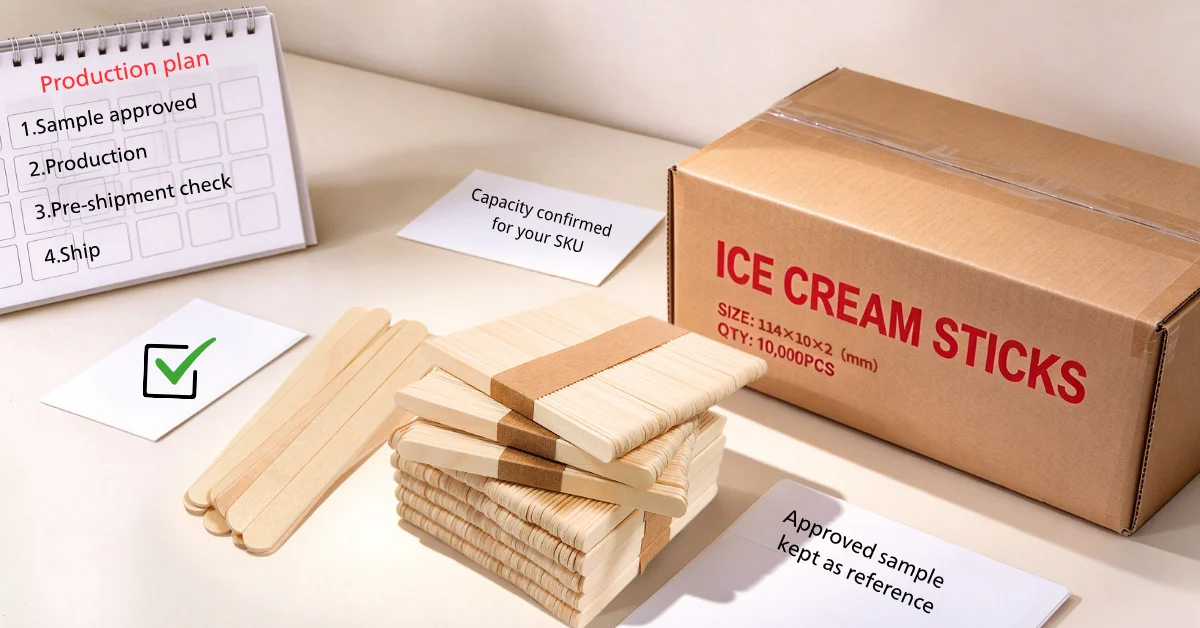
What should buyers check during sample evaluation?
How should sample approval be documented?
03How Is Quality Controlled and Kept Consistent From Batch to Batch?
Which quality characteristics should be controlled?
Characteristic Why it matters on the line How it is usually verified Dimensional consistency across the lot Wrong dimensions change insertion depth and product weight Calliper measurement across a defined sample size Straightness and warping Bent sticks misfeed, tilt the product or break in the mould Curve, zig-zag and banana limits measured separately Smoothness, splinters and edge defects Splinters reach the consumer and can tear the wrapper Visual sorting and surface inspection Moisture content Too much causes deformation, cracking and mould; too little makes the material brittle Kiln-drying records and moisture testing Natural-material defects Insect holes, knots, decay and surface mineral lines, plus visible contamination Visual criteria agreed in the specification 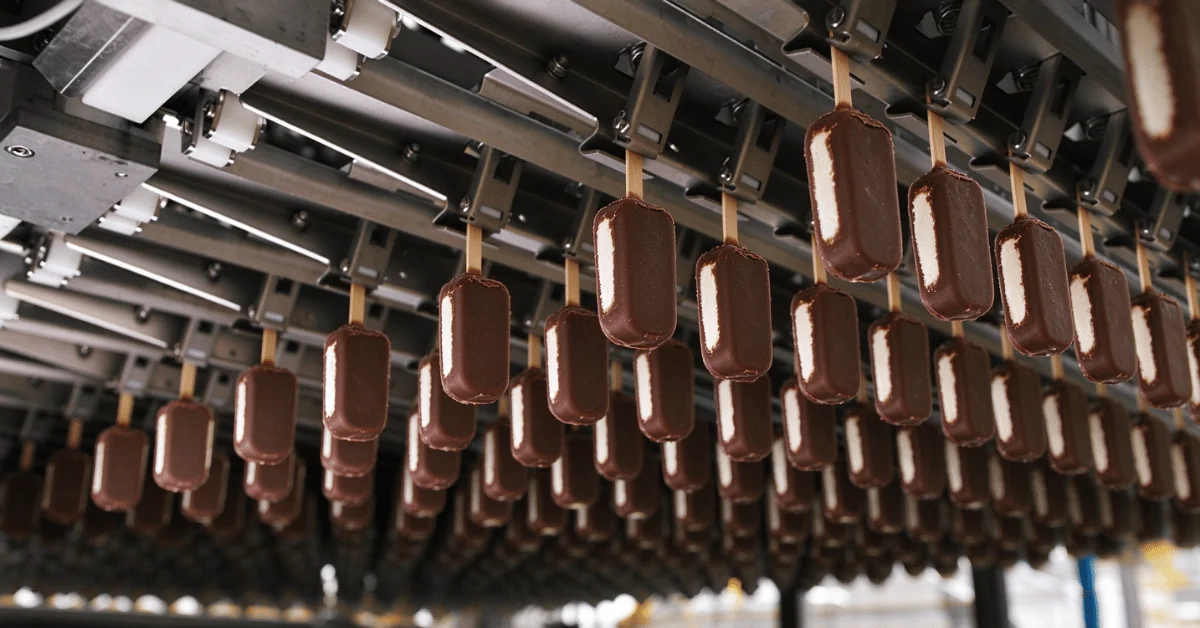
What evidence should a supplier provide?
What should buyers ask about batch consistency?
Should buyers place a trial order before scaling up?
04Are the Food-Contact Safety Documents Suitable for Your Market?
Which documents should buyers request?
Document type What it should cover Questions to ask Food-contact declaration or compliance document The actual product and material in your order Does it name the product, or only a similar item? Test reports and their scope The indicators and methods relevant to your market Which issuing body, which scope, which test date? Material identification and traceability Species or material source and how it is traced Can raw material be traced back to a lot? FSC chain-of-custody documentation Certified material scope, if certified fibre is a purchasing requirement Is your product inside the certificate scope, and will the invoice carry the claim? What should be verified before approving the documents?
Where to read the standards yourself
05Is the Supplier's Production Capacity Compatible With Your Order Volume?
What production details should be confirmed?
What should buyers ask before accepting a delivery commitment?
06Have Packaging, Shipping and Delivery Responsibilities Been Agreed?
07How Can You Verify a Supplier's Reliability and Manage Risk Before Paying?
Look for evidence, not only assurances
What are the warning signs of an unreliable supplier?
What if a supplier has made similar promises before?
08A Pre-Order Checklist for Bulk Wooden Ice Cream Sticks

Checklist item Section Evidence to hold Written product specifications and tolerances confirmed 01 Signed specification sheet Pre-production sample approved against defined criteria 02 Approved reference sample Quality inspection methods and acceptance limits agreed 03 Inspection criteria document Batch identification and traceability requirements confirmed 03 Lot numbering and COA format Applicable food-contact documents reviewed 04 Reports checked for scope and date Production capacity and lead time discussed 05 Written production schedule Packaging and shipping responsibilities agreed 06 Packing list and Incoterms confirmed Payment terms, claims process and corrective actions documented 03, 06, 07 Signed order terms Supplier commitments supported by verifiable evidence 07 Audit report or factory visit record Frequently Asked Questions About Bulk Wooden Ice Cream Stick Orders
What should I check before ordering wooden ice cream sticks in bulk?
Is approving a sample enough before placing a large order?
What documents should a wooden ice cream stick supplier provide?
How can I verify a wooden ice cream stick manufacturer's reliability?
Should I place a trial order before committing to a large volume?
Conclusion: Confirm the Evidence Before You Commit to Volume